
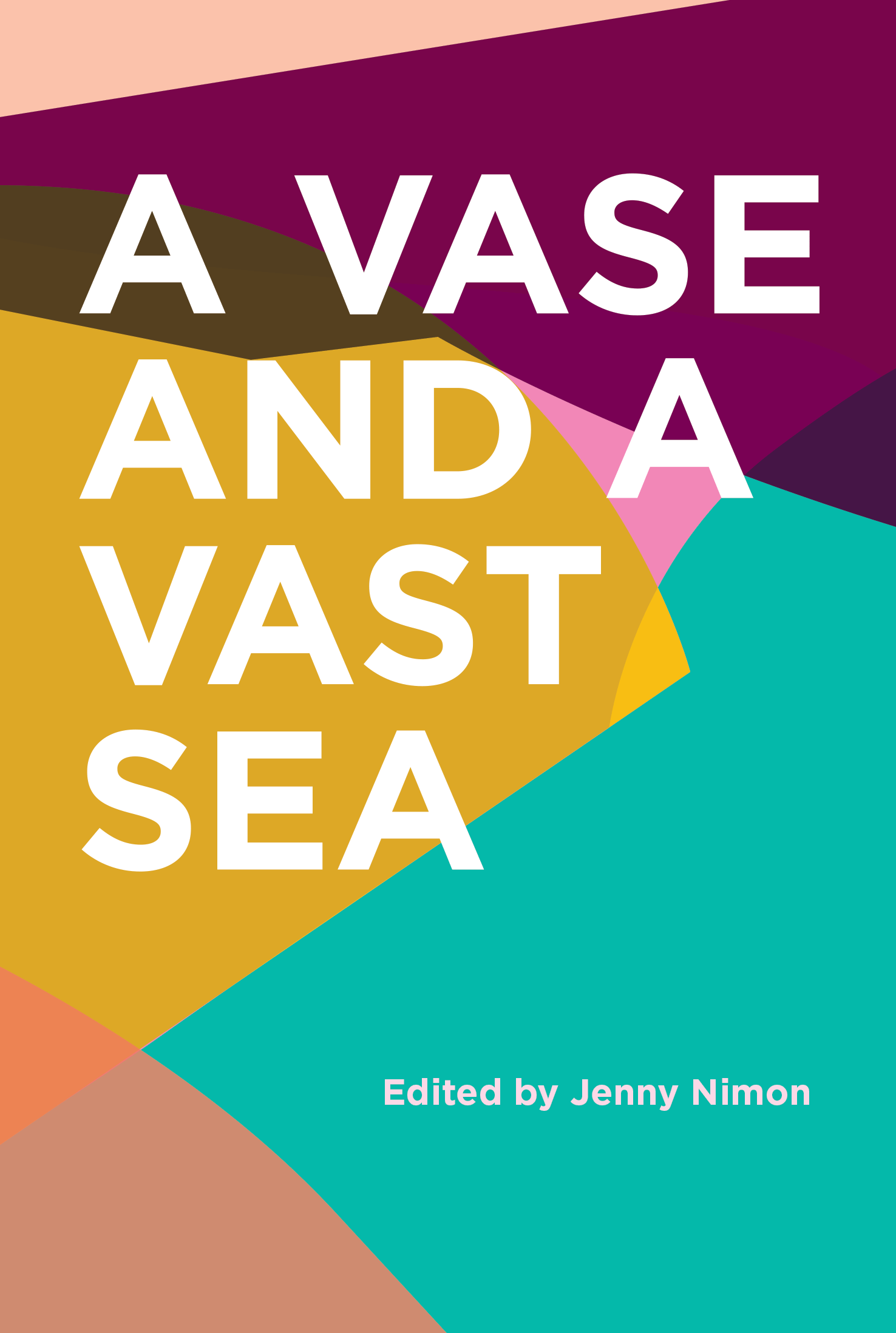
Book Review: A Vase and a Vast Sea
A review of A Vase and a Vast Sea anthology from Escalator Press.
By Carter Imrie-Milne
A Vase and A Vast Sea is a charming anthology of poetry and short prose fished up from the many-fathomed archive of the 4th Floor Journal, the digital platform for students of the beloved Whitireia Creative Writing Programme, which, sadly, had its last year in 2019. The collection as a whole is wonderfully eclectic. Even without referencing the authors biographies, the sheer variety of tone, form, content and style makes it apparent that the Whitireia alumni were a talented and diverse crowd. This is no accident. The Whitireia Creative Writing Programme was founded in 1993 and, in Mandy Hager’s words, quickly established a reputation for "its diversity of students and the nurturing nature of [its] programmes.” At a time when university writing programmes were still much too homogeneous, Whitireia was a space in which anyone who had something to say—regardless of their background—could expect to find the support and guidance they needed. Unfortunately, the progammewas discontinued last year as a result of controversial cuts in funding at the polytechnic after 27 years. It was a living example of how diversity invigorates creative life, with more than 220 publications from graduates as diverse as Alison Wong, Tusiata Avia and Mandy Hager. If A Vase and a Vast Sea is a memorial to the programme, it is also a joyous celebration of what it achieved and a testament to the value of nurturing the talent of a more representative slice of our country, so that their experiences and perspectives can be made known through their own words. The collection places emerging writers alongside respected authors such as Renée, Maggie Rainey-Smith, Anahera Gildea, Barbara Else, Tim Jones and Rata Gordon.
A delightful disregard for continuity in the space-time-and-subject-matter continuum is part of the magic of any anthology. This one is no exception—Jenny Nimon, the collection’s editor, has counterposed the pieces marvelously. Each arrives as a lively surprise, and the shifts in register and changes in focus are continually refreshing. You may find yourself in the company of literal-minded children who’ve packed a lunch and gone looking for Jesus in their neighborhood and then, a couple of pages later, awaken among phosphorescent dust clouds in Central Asia, on the salt-plain remains of what was once the Aral sea. If that sea is no longer so vast as it was, the same cannot be said for that sea of the collections title—the vast sea of human experience—upon which this book sets sail. It’s not a large vessel at 130odd pages but the crew are many, wise, eloquent and companionable.
The poems, otherwise unconnected by theme or circumstance, inevitably share some key preoccupations. The most tangible is an understanding of place and how the environment we identify with shapes our identity, and how we see. Rata Gordon’s ‘I find slaters' foregrounds the connection between her poetry and the natural world:
I am rifling through this poem
trying to find
its hidden meaning.
If I rifle through fallen leaves
I find slaters
Her search for meaning in her poetry—and in her life, perhaps—is embedded in an experience of exploring and investigating the natural world. What at first glance seems like bathos: searching for meaning and finding slaters, is, however, redeemed by the realization of a kind of cyclical, self-generating vision of ecology which concludes the poem, which recycles its own metaphor as a conclusion: “The leaves are being digested. / The poem is eating itself."
At one point, Gordon identifies a tree from which, perhaps, the leaves fell: the Taraire, a common canopy tree endemic to the north island. This is a regular occurrence in the collection— a kind of specificity not of the city/street name variety, but rather of particular places in nature. Trish Harris plays with the dynamics of place and personhood marvelously in “Blackberry-picking heaven”, where her discovery of an especially abundant source of blackberries prompts first possessiveness, resignation to sharing, then a sense of loss when it is converted into “a neat grass verge and a new fence”. Finally, the cycle is completed with the hope that, next summer, “with a little bit of roaming, we’ll find another patch.” The actual part of the country in which this has taken place is never specified, because it is as much a place in Kiwi imagination as in reality: a “heaven” in which a little part of nature which is not ours in accordance with any property law, nevertheless provides a source of joy and sustenance. These pieces, and many others in the collection, are alive to the ways that nature informs our every day experience—as a site for the imagination to take root, for the contemplation and negotiation of self, and the sometimes inconvenient, sometimes joyful reality that we must navigate and negotiate the natural world with other people.
Another, somewhat ambient, aspect of the collection is the nostalgic note sounded by lots of writers in different ways. Sometimes the feeling is triggered by cultural detritus from the last 15 years (the duration of 4th Floor Journal’s existence) which has washed up in a poem, such as the catalogue of movies attended by the speaker in Tim Jones ‘Tuesday’ ("Van Helsing. / Hellboy. Harry Potter 3.”) Other times, the origin of the feeling is vaguer. In the elegiac ‘That Summer’ Maggie Rainey-Smith’s rekindles a memory of a summer the reader never had and yet somehow remembers: “our legs stretching / and we are freckled / brown, adjusting our / elegant fingers”. The recurrence of “we” and “our '' throughout gently draws us into a dream of a past which is not our own, and yet, so palpable are our own memories of summer, we are able furnish the dream with details and feelings native to our own experience. Rainey-Smith ushers us into her memory, but it is our nostalgia with which it is imbued—our own sense of longing for those radiant days lost to the ebb of the seasons. Alison Glenny’s poem, 'Notes for a biography', tries to describe the element of which this nostalgia is composed. Biography—that is, the drawing of a life—is a futile exercise, like trying to fill a vase with a vast sea. However unsuccessful our attempts to fit life into prose, poetry, or a decorative container without handles, the inadequacy of the vessel nevertheless stands as a testament: both to the immensity and significance of life, and to our deep-seated desire to try to share it with others. In the terms of Glenny’s poem, nostalgia, longing, and loss all reference an “object” which can only be "evoked by its absence”.
This collection, which is so full of life and the energy and emotion which life inevitably generates, makes one sad to contemplate the absence of the programme which was the impetus for the collection and which meant so much to the writers in it. That absence and what it means is nevertheless evoked beautifully by quality of the writers and the writing which it produced. Even if we do not have the programme any longer it is a great solace to know that those who were involved with it will continue to write for many decades to come.
Purchase A Vase and a Vast Sea from Escalator Press online here.
Reading list: Kiran Dass’ Best Ever Booklist
Kiran Dass’ personal library: the books she loves, stands by and returns to.
By Kiran Dass
When Claire Mabey asked me to compile a list of what I reckon are the Best Books Ever, it seemed like such an insurmountable task. I’m used to being asked to create lists that fit a certain theme, or finding books for a specific brief for a specific person. But this personal list is not a list that is trying to be all things to all people. It’s all about the books that I love, that have shaped me as a reader, writer and person over the years. All of these books have been definitive, unforgettable reading experiences for me and are titles that I still stand behind, no matter how much time has passed since I first read them.
The Years (2017)
Annie Ernaux
Extraordinary! As in, jaw-dropping. This is a radical approach to the memoir, it's a collective history that is actually a kind of work of reportage. A generous and attentive book, It’s where autofiction, biography, history and sociology intersect. Written by French author Annie Ernaux, it’s her memoir but is actually a collective biography. It spans her entire life beginning in Normandy 1940 when she was born, and through the decades up to 2006. She calls it a compilation of abbreviated memories. It’s told in the third person, there’s no ‘I’ or ‘We’ as she records her personal experience against the backdrop of wider social and cultural change, and we sweep through historical events as she remembers them. It is the story of all of us. We move through history, politics, the arts, feminism, immigration, unemployment, the pill, legalisation of abortion, the aids crisis, the collapse of the Berlin wall and how we have become a consumerist society. We look at the first heart transplant, the first colour TV, the first Walkman, and remember the “Y2K meltdown”? Ernaux spent decades taking notes in preparation for writing this book, so it’s literally her life’s work. Exacting and journalistic, The Years is attentive, generous and inclusive. It’s absolutely majestic in its wide scope and I found it exhilarating.
Get your copy here.
Lost in Music: A Pop Odyssey (1987)
Giles Smith
This is the book that High Fidelity tried so hard to be, and is the bar against which I judge all music memoirs. Having read it seventeen times, it’s my most re-read book and the pleasure has never diminished. It’s my comfort read. John Peel was a big fan of this book, and who are we to argue? A sportswriter and music journalist, this is Smith’s insider’s account of what it means to be a music head. He vividly evokes what it’s like to grow up obsessed with pop music and the heady adventures of finding it, buying it and trying to play it. From discovering a love of music as a child in 1960s Essex, failed relationships, his struggles in the brokenarsed cult band Cleaners from Venus and his often hilarious experiences as a music journalist, Smith perfectly captures the thrill, excitement, madness and pain of being a music lover, so anyone who has ever bought and loved a record, been to a gig or played in a band ought to read this. It’s crack-up funny, charming and warm.
Ask your local indie bookshop if they can hunt you down a copy or check out Better World Books.
The Patrick Melrose Novels (2012 as a collection)
Edward St. Aubyn
Warning! This brutal suite of five semi-autobiographical novels is so utterly moreish you won’t be able to get enough of the savagely despicable characters. Even though I have the entire collection of this series of fives novels, I’ve deliberately never read the final book At Last. What am I saving it for? I just don’t want the series to end.
With wonderfully droll titles like Never Mind and Bad News, these novels are a critique of the messed-up English upper classes, and chart Patrick Melrose’s decadent and highly dysfunctional life as he grows up and deals with toxic parents, alcoholism and heroin abuse. His selfish, disinterested and pill-popping mother Eleanor unforgivably turns a blind eye to the ongoing and horrific abuse Patrick suffers at the hands of his father David, leading Patrick on a devastating trail of self-destruction. I discovered this series after publisher Fergus Barrowman and ex books and culture editor at the NZ Listener Guy Somerset both independently and enthusiastically recommended them to me. Grateful.
Get your copy here
Music for Torching (1999)
A.M. Homes
I chanced upon this incendiary novel while shelving at the bookshop where I worked. Attracted by the title (named after a Billie Holiday record) and stark Granta cover, I read it, and found it the most intense, hyper real literary experience. I’d told a colleague I was reading it and wide-eyed, she told me about the time she had read it while looking after some children in a playground. She was completely immersed in the book as the children ran amok around her. The first chapter of Music for Torching began as a short story in the New Yorker, and it’s a firecracker of an opener to this novel about infidelity, boredom and violence. We meet Elaine and Paul, an American middle class suburban couple. They have two sons, a beautiful home, and a seemingly normal, mundane life. But Homes scrapes away the veneer of the American Dream and reveals a perverse underbelly in this deeply unsettling and provocative novel. It’s irresistible and caustic reading. “Homes doesn’t so much critique suburban American life as shoot it, stab it, chuck it in the back of her car and drive it into a lake,” a reviewer wrote in The Times.
You can read an interview I did with Homes, here.
Chat with your local indie bookstore about finding you a copy.
Easter Parade (1976)
Richard Yates
Joan Didion says this is the best Richard Yates novel, and while I love them all, I do agree. An exquisite observer and writer, his novels are infused with a deep and unshakeable sadness, but there is always empathy humming below the surface. The opening line of The Easter Parade sets the tone: “Neither of the Grimes sisters would have a happy life, and looking back it always seemed that the trouble began with their parents’ divorce…” The sisters in question are Sarah and Emily, and in this book we follow their lives from the 1930s and how they have been affected by their alcoholic mother and distant newspaper worker father who lives in the city. Yates’ rinsed out, alcohol-soaked and desperate characters navigate the banal brutality of everyday life, often against the austere steely grey tones of New York City. The Easter Parade, like all of his stories, deals with the crushing of the human heart, the vortex of moral regret, despair, broken dreams and broken people.
Talk to your local indie bookstore about ordering you a copy (or check your library).
The Secret Diary Of Adrian Mole Aged 13 ¾ (1982)
The Growing Pains of Adrian Mole (1984)
Sue Townsend
Sue Townsend was such a brilliant writer and satirist! And her immensely quotable creation Adrian Mole is one of my enduringly favourite literary characters ever. I got the books out from the Waipa Primary School library in Ngaruawahia when I was growing up. I loved that bright red lipstick on the cover. Hot on the heels of my inexplicable first crush ever, which was on Duran Duran’s drummer Roger Taylor (of all the members?!) came the socially awkward and bumbling fictitious character Mole - an insufferable, bespectacled nerd living in working class Leicester under the gloomy shadow of Thatcher. Family life, school, crushes (he’s profoundly in love with Pandora, you know), his self-deluded budding career as a writer are neatly trussed up in social and political commentary. And who could forget the time Mole tried sniffing glue and accidentally stuck a model aeroplane to his nose? This iconic opening sequence from the television show based on the books sums the whole thing up.
Townsend continued writing Adrian Mole books, charting his life into middle age. Did you know he went on to be a bookseller? Too relatable. Adrian Mole and the Weapons of Mass Destruction is a hilarious instalment. In it, he is 33 ¾. I remember being a bit annoyed that Townsend didn’t make him 33 ⅓ - a record speed age. Is that too nerdy?
Get your copies here
Passport to Hell (1936)
Robin Hyde
When I first moved to Wellington from Auckland, I used to see a handsome fellow around town who always at the same rock shows and film society screenings as me. One day, he sauntered into Unity Books, where I worked at the time. I remember paying close attention to see what section he would squizz first. Art? Music? Graphic Novels? He made a straight beeline for the NZ Non Fiction shelves. “Brainy!” I thought. After scanning them, he came up to the counter and after chatting for a while, he asked for my phone number! Later, he told me he’d come in looking for Robin Hyde, who I'd never read before. I was grateful for the introduction.
With its vivid and harsh realism, Passport to Hell, which journalist, novelist and poet Hyde wrote in six weeks while recovering from morphine addiction, got under my skin. An important New Zealand history and war book, it is an unflinching and gutsy account of WWI anti-hero Private James Douglas Stark (bomber, Fifth Regiment, New Zealand Expeditionary Force) who was hot with his temper and quick with his fists. A staunch advocate for the underdog, Hyde tells Stark’s tales from the frontline and beyond with a diagnostic journalistic eye and novelistic tension. Her own life story is just as gripping. (And yes, the fellow and I are still together).
Get your copy here.
Rip it Up and Start Again: Postpunk 1978-1984 (2005)
Simon Reynolds
In my house, we refer to this as ‘the yellow pages’. It’s a book I still constantly refer to and my own copy is dog-earred, riddled with marginalia, underlinings, and is marked by tea spills. Post-punk rolled up its sleeves and took care of the promise and unfinished business that punk rock left behind in the mid 1970s. Music critic Simon Reynolds has written a fairly definitive deep dive into the bands, labels and zines of post punk music. Reading this book gave me real insight into looking at music from a regional perspective - not just Manchster, but Sheffield, Glasgow, Leeds and Liverpool. How scenes are formed. Rip it Up helped expand my record collection, and shed new light on the records I already had. Full of interviews and esoterica, it’s an important artefact to me - a solid and intelligent look at the most sonically adventurous music from the time period, and the cultural, social and political conditions under which it was made. This is some of the most charismatic and insightful music writing I’ve ever read.
And look. Here’s a playlist I made to accompany the book.
Get your copy here
Stoner (1965)
John Williams
I will never forget the impact and the way I felt when I first discovered this book. John Williams was a writer of such perfection. Published in 1965 to little fanfare, Stoner soon went out of print and slipped under the radar until it was re-published in 2006 to great sensation by the terrific New York Review of Books imprint. It follows the life of William Stoner, a quiet and unmemorable man who comes from a stoic farming family and who goes on to study agriculture at university. But Stoner falls in love with literature, so ditches his farming studies for writing. He goes on to teach literature and establishes a career in academia. We follow his studies, his teaching life, his friendships, and the bitterness of university politics. Stoner doesn’t leave much of an impression on anyone, not even his toxic wife who treats him terribly. But what makes him such a memorable literary character is his absolute dedication to and immersion in writing and teaching. He’s got this quiet strength of character and this love of the written word forms the spiritual core of Stoner. Williams was immersed in the world of literature himself. He taught and wrote, and edited literary journals. Stoner is a powerful love letter to literature and is written with such beautiful depth, clarity and intelligence. It’s plainly written, almost blunt. There are scenes of such immense sadness and beauty that it just sort of hums. I remember reading somewhere that Williams walked in on his typist when she was typing Stoner, to find she had big rolling tears streaming down her face.
Talk to your local indie bookshop about finding you a copy, or check out your library.
The Lonely City: Adventures in the Art of Being Alone (2016)
Olivia Laing
With The Lonely City, Olivia Laing elegantly and dexterously dances around and merges reportage, memoir, biography, art and cultural criticism in what is essentially an enquiry into urban loneliness. She looks at connectivity and intimacy, how cities can in fact be lonely, isolating places, and how loneliness doesn't actually require physical solitude.
And what do so many of us turn to when feeling lost or lonely? Art. So Laing looks at the lives and work of artists (including Edward Hopper, Andy Warhol, Alfred Hitchcock, and I’m grateful for the introduction to the work of David Wojnarowicz) who weren't necessarily inhabitants of loneliness, but whose work is sharply resonant and hyper alert to the gulfs between people.
This is the perfect galvanising read, and one (along with all of Laing's non fiction works) that I return to time and again for literary solace. Beautifully pitched, The Lonely City is alluring and brainy. An enquiring and sensitive writer, Laing is such a joy to read. You can read an interview I did with Olivia Laing here.
Get your copy here
Reading list: Talk so loud
A reading list in response to themes of silencing, labelling and pigeon-holding. A list for celebrating, listening and letting the voices be loud!
We had a quiet lock-down. And now it’s time to be noisy again.
I’ve been thinking about gazes: male gazes, sure, and western gazes, definitely. I’ve been thinking about the long generations of silencing: of women and of intersectional folks – whether women or men or both or neither – definitely.
But first, a short whakapapa is important. My grandfather on my mother’s side was a refugee from Turkey, my grandmother displaced to a series of kāinga after she was orphaned, my mother immigrated to Aotearoa from Greece when she was 22, my father, from Ōtepoti, went his own way when I was six and we grew up as if he’d never existed.
And before this, the stories. I feel complex things when I think about ancient Greek history and mythology. It’s Greek, but is no longer just Greece’s. That history was adopted by the West while Greece was occupied for hundreds of years, missing many fab moments like the Renaissance, scientific revolution, the Enlightenment. And culturally, Greece is much, much more eastern than western, though is branded western and white.
What I’m saying with this is that stories don’t start at a finite point.
Do we want all the stories? Differently told stories? Intersectional stories? Dominance, and the idea that somethings or someones can be known fully, is so extinctive, and rude, and end-game anthropocene. So we need to constantly reset. Women, othered, colonized, refugees, migrants, kids of diasporas have no choice but to offer antidotes, and hurl flares at all the unknown backstreets.
The books I chose to kōrero with Michalia and Laura in this reading list talk to each other about exile: from voice and selfness, against franchise or privilege. They reject the definitions imposed upon them, and instead self-define and talk out loud so we can hear them.
I hope you can get your hands on some of the following lightning stories, and support your local booksellers in the time of coronavirus.
Let’s open with a tetraptych of four books that tell the stories of unsilenced selves who were ancient or fictional, famous or not.
First is Jeanette Winterson’s Weight where Jeanette retells the Atlas myth (you know: the one with the guy with the world on his shoulders) but switches up the tired old (young, white, male) hero trope to become Atlas herself and emancipate him/her/them from his/her/their own personal history. Then, there’s Ali Smith’s Girl Meets Boy where she says, ‘It's what we do with the myths we grow up with that matters’. The book is a wondrous repositioning of the Iphis and Ianthe myth where Iphis is born a girl though grows up a boy, and loves Ianthe as both or neither. Desire, gender and identity are synthesized, and Ali gives the lovers back their porousness. Helen Rickerby follows, with her How to Live, where she does some serious empowering of Hipparchia for one. In her ‘Note on the unsilent woman’, the philosopher is illuminated, and the very idea of silence interrogated, (‘4. Silence isn’t always not speaking. Silence is sometimes an erasure’), and then reclaimed (’19. Silence might not be not speaking. It might be listening’). And lastly, Anne Carson. She takes on Proust in The Albertine Workout and liberates Albertine, whom Proust based on his chauffer Alfred, and with whom he was in love – and who, according to a world expert on Proust – ‘a reader may safely and entirely skip’. From the opening: ‘2. Albertine’s name occurs 2,363 times in Proust’s novel, more than any other character… 4. On a good 195 of these pages she is asleep.’ – A lot of waking up happens in these four books.
Get your copy of Weight here
Get your copy of Girl Meets Boy here
Get your copy of How to Live here
You can access The Albertine Workout on the London Review of Books here.
Life on Volcanoes: Contemporary Essays – Tulia Thompson, Tze Mink Mok, Courtney Sina Meredith, Ruth Larsen, Tui Gordon and Janet McAllister (editor)
Here’s another chorus of women, this time in a single book which everyone must, must read. In Volcanoes the five poet-essayist-writer-thinker women blast out in full-throated volume about poverty, pain, boundary, healing, love, diaspora, persecution and responsibility in Aotearoa – and I love that Greek people imagined /imagine volcanoes to be the results of huge releases of trapped air from deep inside Mountains. I was at Tulia’s, Tui’s, and Janet’s ‘Voices Rising’ session at Going West last year in 2019, and it was of heat and of heart. A serious no-joke call to righting a lot of wrong. it amazes me how renegade and activist it still feels when a group of women call shit out.
Get your copy here
Night Sky with Exit Wounds – Ocean Vuong
I deeply loved the code-switching in this book (‘In Vietnamese, the word for grenade is “bom,” from the French “pomme,”/meaning “apple”’); and after reading Night Sky I thought Ocean might also be part-spirit from another world (but let’s watch that whole exoticising/ fetishising thing). Ocean is gay, was a refugee with his family until they migrated to the States, and his actual physical liminality is central to his poetry. But he is also luminal – definitely, of light and for light. He lights up grief, war, memory, family, sexuality, and otherness with all of his senses – and his ability to slide under your warm skin is one of them. ‘Stars were always what we knew they were: the exit wounds of every misfired word’ he says. His intersectional voice guides to the above over the solid confines.
Get your copy here
Girl, Woman, Other – Bernadine Evaristo
There’s a lot to be thankful for in Bernadine. The daughter of her English mother, of her father migrated from Nigeria, she is an experimenter and an iconoclast. In a 2013 interview with Bookslut, she said, ‘I see myself as a storyteller who uses whatever forms seem to fit the story I want to tell. I started off as a poet writing verse dramas for theater, then just wrote poetry, then moved into the verse novel genre….I (maybe?) invented the novel-with-verse genre, which used verse, prose, prose-poetry, scripts, and other non-literary techniques’. For me, hybrid comes to my mind in the best possible sense in this book too, because hybrid is related to hubris, to insolence; and in Girl, Woman, Other, Evaristo celebrates insolent selves, spaces – and form. Amma, the awesome, glorious, black lesbian theatre director, might be the main character, but it’s the complex chorus of subsequent voices – who all gather to sing their stories, in their ways – which collectively make the texture bullet-proof. The text is fast, present, more poetry than prose, (I reckon), or neither, with an awesome disregard for rules and punctuation. There are multiple ways to tell stories.
Get your copy here
He’s So Masc –Chris Tse
Multiplicity is the idea that also strikes me when I think of Chris’ rich, moving, honest, second book. In an interview with Paula Green he said that ‘sometimes I do feel like I’m performing the part of a Chinese New Zealand writer…this book was a chance to draw from the intersectionalities of who I am’. From the book:
I’ll go to my next grave wondering
whether I pushed them hard enough to never settle
for being the token Asian in a crowd scene
(from ‘Punctum’)
‘Push, ‘never settle’, ‘crowd scene’: these signal the many territories in the text, and they all influence and check each other, the lines as unique as a fingerprint. When I read Chris’ line, ‘I could step into a crowd and never resurface’, I remember bumping into him at an Interpol gig at Vic Uni years ago; he was brilliantly dancing.
Get your copy here
If They Come for Us – Fatimah Asghar
Fatimah’s book is so powerful and so heart-rending, it’s hard to know what to meaningfully say about it from the outside; and it’s the kind of book you read through again and again, even though it’s relentless enough the first time through (though there is deliverance also). She slices through identity, feminism, religion, war, death, race, pain; and her experiments with form – there are maps, games, flipped text – are a crucial part of the space. Fatimah’s parents immigrated to the States from Pakistan and Kashmir, and she was an orphan by five after losing both of them. Her story-telling doesn’t need veneer, restraint or definiteness.
‘From the moment our babies are born are we meant to lower them into the ground? To dress them in white? They send flowers before guns, thorns plucked from stem. Every year I manage to live on this I collect more questions than answers.’
(from ‘For Peshawar’)
Get your copy here
You Don’t Love Yourself – Nathalie Sarraute
Nathalie Sarraute [or Natalia Ilinichna Tcherniak] immigrated with her father to France, a child from Russia, and became the queen of the French nouveau roman. I went through a Nathalie phase a few years back and she totally transformed the idea for me of what is possible in form and intention: her work never settles, it’s all about the doubt and unfixedness. In You Don’t Love Yourself, she dissolves the narrator, (the self), into multiple voices and spaces, and translates this fracturing and fragmentation with ellipsis and an unorthodox anti-crafting of plot (or no-plot): because again, ego is not a single, rational, robust thing, but mobile and constantly talking. In an interview, she called the book a dialogue.
Request a reading copy at the National Library of New Zealand by clicking here
As the Earth Turns Silver – Alison Wong
I read this when it came out ten years ago, and remember having slightly mixed feelings even as I thought the poetic writing very beautiful. Lately, I’ve come to question these older ideas. Though it won the NZ Post Book Award, I remember some of the reviews not liking the light quality of the writing; but now I wonder: who were those people to say? I’m considering Wong’s choices of form and language as functions of a less explaining storytelling. It’s so exhausting when stories told by non-dominant culture storytellers are looked at through dominant culture lenses (good writing/not-quite-as-good writing). The story follows two Chinese brother grocers at the turn of the century, a Pākehā woman and her family. So: racism, voiced cultural history, voiced feminist history.
Get your copy here
Just Give Me the Pills – Koraly Dimitriadis
Koraly is the Greek Cypriot-Australian poet and performer, who wrote Love and Fuck Poems, and she is wielding some fire. I read her novel-in-verse exploration of gendered roles, repression and liberation, a few weeks ago when I was feeling really fucked off myself. Here’s another opening from ‘Wedding Day Photography’: ‘arms as thin as the branches her mum would cut from the tree to smack her with…when she walked down the aisle of the church she was so happy her chest and shoulders broke out in a love-red rash…’. Koraly’s writing is antidote to shushing, (‘Why don’t I shut the fuck up?’), her voice is resuscitating. (She also said ‘one thing I am certain of is I am not white, and if anyone calls me that, I get angry. Really angry’ in her article ‘I’m Greek-Cypriot. Does that make me a Person of Colour?’ Contentious).
Get your copy here
Ransack – essa may ranapiri (Ngāti Raukawa)
Language, or rather the newing and hybriding of language, is the major thing that really hit me essa’s book. Yes, I loved the kōrero with Orlando, but I also loved the earth of the poems – the page or canvas (or setting or context or trap or air) on which the words (or parts of) split, became isolated or ecstatic. I felt I was watching play and protest salvage or defy blanked terrain. There was body in this work, hot, spread out, unruly. I agree with Jackson Nieuwland’s response in their Pantograph review of the gorgeousness of the nonstandard ‘it consumes it and is made by it planet and body’. (Next, I’ll sit with essa’s echidna, the [not/Greek] ‘daughter of te Ao Māori’, and other forces).
Get your copy here
Bloodclot – Tusiata Avia
Let’s circle back to myth, to automythography, (or Audre Lorde’s biomythography idea), specifically to Queen Avia: Samoan-Palagi-wahine toa. Nafanua, Samoan Goddess of War and Tusiata merge to make one molten, moving, time-travelling shape-shifting, spiraling force field. Here there is body/bodies/body parts, here there is a crossing between spaces that seems ethereal and peopled only by ghosts. I could include all of Tusiata’s books in this list, but Bloodclot has been particularly red and possessing of me. Psychological, violently redemptive, insolent, it’s on another plane.
‘Nafanua on the other side of the world climbing into her Triumph
she covers the mirrors, pulls out the choke and roars off into the Va’.
(From ‘Nafanua and the New World’)
Get your copy here
Reading list: Love in Isolation
Sinead Overbye’s list of books about love, isolation and sometimes a little of both.
By Sinead Overbye, 29 April 2020
Love in Isolation
The loose theme of this list is ‘love in isolation’. Some of these books are more about love. Some of them are more about isolation. Most of them, I think, cross-over between the two.
It was important for me, in my reading list, to include as many lesbian stories as possible, but not all of these novels are queer. For me, finding love stories that I relate to or find compelling is kind of difficult. With such a glut of hyper-erotic lesbian trash available on Netflix, I sometimes think, what the hell? Where am I? Am I even real?
Reading stories that I can so specifically relate back to my own experience has been some of the most powerful reading I’ve done in my life.
So, I’ve chosen books that have really spoken to me, or have somehow shaped my idea of who I am. I’ve chosen books that have entranced me, hit me in the guts, made me laugh and made me cry. Even if you don’t have the same experiences as me, I hope you find something in this list that astonishes you.
A note on getting copies of the books: I’ve added links to e-books and audio books. You can also support your local bookshop and ask them if they have a copy in stock or if they can order one in for you.
Like by Ali Smith
Ali Smith is one of the best living authors, and anything she writes is incredible (other top recommendations include Hotel World and Autumn). But if you can get hold of a copy of her debut novel Like, I’d really recommend it. Told in two halves, Like is a rich and complex tale about a love relationship that shapes the course of Amy and Ash’s lives. Both halves are so tonally distinct, and yet each piece of information we’re given about the characters, their thoughts, desires, and their past together is timed perfectly. One thing I loved about the book was that at the end I was left with more questions than answers, but not in a depressing way, it just felt realistic. Incredibly woven, and bittersweet, Like is a lesbian romance like no other.
Check out your local library: here it is at Wellington City Libraries. Or ask your local bookshop if they can sleuth you a copy.
We Have Always Lived in the Castle by Shirley Jackson
This book is all about isolation. Mary and Constance have been self-isolating from their entire village for six years, along with their Uncle Julian who, after a dramatic event that killed the rest of their family, has ended up in a wheelchair. When a distant cousin shows up and tries to woo Constance, Mary resorts to casting spells around their property to protect them. My favourite thing about this novel is the voice. Mary is an extremely compelling narrator, and weaves her own sense of humour, logic and magic into the story she tells. Shirley Jackson is a master of writing creepy narratives with a light touch. Anyone who’s read her short story The Lottery will know how good she is at writing about freaky small towns! This book also has one of the best first paragraphs in history. If you’re not instantly hooked, I’d be surprised.
In the Dream House by Carmen Maria Machado
I have mixed feelings about this book, but after mulling it over for months, I think that’s a good thing. This memoir tackles the issue of lesbian domestic abuse, in a way that is thoughtful and evocative. Carmen Maria Machado’s prose isn’t for everyone, but I really love the texture of her work, and the way she evokes fairy-tales and myth to tell her story (another great example of this is in her short story The Husband Stitch). In spite of the book being almost too abstract or vague at times, In the Dream House is brilliantly researched, with some awesome experiments with form – she even writes her own a pick-a-path! I’d recommend it to anyone who wants to see what you can do with the memoir form. Not everyone’s cup of tea, but I think it’s an incredibly important book that’ll be influential to many queer people, looking for someone to tell their story.
Circe by Madeline Miller
Another isolation book, Circe is a modern-day epic, telling the story of Circe, the daughter of Helios, who is banished to the mythological island of Aeaea. Circe narrates her entire life, condensing thousands of years of human history into 384 pages. This book exploded my idea of what story can do. Sometimes I feel like novels only allow themselves room to explore one arc in a character’s life, but Circe is a life story that just keeps rolling. It allows us to see this character change, adapt, and continue living after moments of epiphany or conflict. You can tell Madeline Miller has done so much research in writing this book. It’s a very rich tale with a lot of weight to it. It also offers a fantastic form of escapism – you feel like you are right there with her, shrinking men into pigs on her island, swimming to the darkest depths of the sea. It’s a book that keeps giving. The prose shimmers on the page. Honestly. It’s just so good.
The Bone People by Keri Hulme
Another epic, and a must-have with the theme of love in isolation. Kerewin is one of my all-time favourite literary characters. I’ve been thinking about her a lot, during my isolation. One of the best moments in this book is when she first encounters the 7-year-old boy Simon, in her window, after which her life is never the same. In spite of Kerewin not wanting anyone else to alter the course of her life, she is unable to control the impact that Simon and his dad Joe have on her. Keri Hulme is a real master of evoking physical sensation, and also a sense of place. While I’ve spent very little time in Te Waipounamu, I can feel the atmosphere and sense of place in every word. The novel exists in a landscape that feels haunted. Even though Kerewin makes some pretty drastic mistakes in her life, I think it’s a testament to Hulme’s skill and bravery that we are compelled to keep reading.
Tahuri by Ngahuia Te Awekotuku
This book is everything I wish I could’ve read during my angsty teenage years, and it has stolen my gay little heart. Why didn’t anyone tell me about it when I was young! It’s a collection of short stories following a young girl named Tahuri, who is growing up takatāpui in Rotorua. Ngahuia Te Awekotuku has such a way with words, and her descriptions of lesbian desire are so on point and just… really… sexy. In many ways, it’s a coming of age story, but one of my favourite things about it is that Tahuri knows exactly what she wants, and what she will not stand for. The book provides tonal contrast between moments of despair and degradation with moments of discovery, pleasure and joy. It’s a must-have for any queer Māori. Or anyone really! If you can get your hands on a copy, I couldn’t recommend it highly enough.
Get your copy here.
The First Bad Man by Miranda July
I know this book was popular quite a few years ago, but it never gets old. If you’re looking for something strange, a book to make you question your own prejudices and also challenge your perceptions around pleasure, love and sex, then this is the book for you! Cheryl Glickman, the main character, is so super weird and lives a fairly isolated life. Her observations about the smallest of things truly earn the word ‘quirky’. When Clee, a physically intimidating younger woman moves into her house, Cheryl loses control over her personal space. And then, they somehow fall into this pattern of sex and strange domesticity that is like no other affair I’ve read of before. Miranda July’s writing is absurdist and hilarious. She also has a great reading voice, so if you’d rather listen to a book while you’re on your daily hīkoi, an audiobook version is available on Audible.
Why be happy when you could be normal? by Jeanette Winterson
This memoir, written almost thirty years after her novel Oranges are not the Only Fruit, is a poignant tale about how Winterson grew up queer in 1960s Accrington. She was brought up and raised by her adopted Pentecostal parents, whose religious beliefs led to Winterson becoming estranged from them at aged 16. She discusses her childhood, and also her life in the wake of the novel she published decades before. Being queer in a small town is represented as an extremely isolating experience, and Jeanette Winterson captures this with an upsetting honesty, but also with lightness. I found myself cracking up often at the strange conversations and hilarious quips she scatters into the book. It’s like… the original Priestdaddy, but gay. It’ll make you laugh one minute, and then it’ll punch you in the gut the next.
Listen to audiobook here, or get the e-book here. Or ask your local bookseller to order one in for you.
Faces in the Water by Janet Frame
Janet Frame is a master of writing isolation. If you’re wanting a story to accompany your lonely feelings, this is the one. Brilliantly written, with evocative and imagistic prose, this novel will bind you in its spell, and then screw with your brain – in a good way. It follows the main character, Istina Mavet, through life in two mental institutions, and is incredibly insightful and just so well written – like anything by Frame. One of the main pieces of advice I have with this novel is that you’ll probably get far more out of it when respecting Janet Frame’s own genius, and reading it as a work of fiction, rather than as a work of autobiography. She approaches everything with creativity and lucidity. Chur Janet.
Get a copy here.
Nothing to See by Pip Adam
I had to include this on my list! Which is very naughty, because the book hasn’t launched yet. But mark it in your calendar, people, the next novel from Pip Adam is on its way this June, and it is better than ever! Pip Adam absolutely crushes it with this book. She’s crushed me. I am crushed. The book follows Peggy and Greta, recovering alcoholics who are trying to make a new life after leaving rehab. But that’s such a simplistic plot summary! Anyone who’s read Pip’s Ockham Award Winning novel The New Animals will know she is an author with an incredible capacity to surprise the reader. This novel, while not for the faint-hearted, certainly provides its fair share of original twists. Peggy and Greta have been through a lot when we meet them. They go through a lot when we’re with them. But they are so endearing, that you are compelled to keep reading, wanting the absolute best for them. This book is filled with intensity and moments of panic and pain. But it is also so incredibly brave. It makes me feel brave. Which is a rare experience of reading fiction. I really recommend it to everyone.